
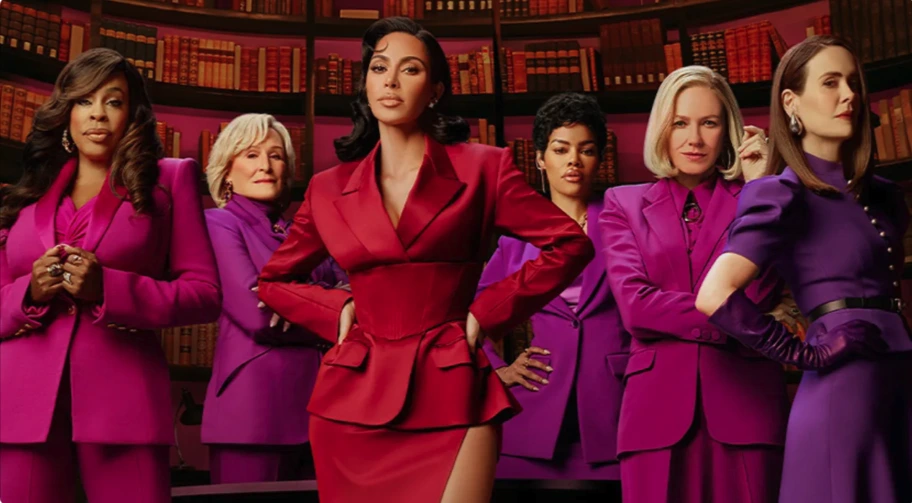
There is a new, much-anticipated Disney show called All’s Fair, starring a star-studded cast: Glenn Close, Sarah Paulson, Niecy Nash, Naomi Watts, and Kim Kardashian.
Not to mention the cavalcade of B-listers in guest-starring roles in each episode, it seemed like a goldmine! I put it on my watch list and eagerly awaited its release. But then the reviews started rolling in. The critics trashed it, literally zero stars, zero! The verdict was in: it seemed high-glamor, fantasy-driven, set in a world where women run the most powerful law firm in California, and there is no-fault divorce.
Table of Contents
The Show
The show focuses on the clients at this fictional (if not impossible) high-powered divorce firm and on the messy personal lives of the divorce attorneys, played by Glenn Close, Kim Kardashian, Naomi Watts, and Niecy Nash, a private investigator. All’s Fair is glossy, dream-like, and almost surreal at times. The cases are about outrageous wealth and despicable behavior, where women come out on top financially in their divorces when they hire these powerful, crafty female divorce attorneys. The premise sounds great. I was so excited for the release. Then I began reading the reviews, which were unanimously terrible; the show was panned. Zero stars, even from female TV critics. I sensed there was more going on than just personal opinion or subversive marketing forces. I decided to watch All’s Fair anyway, and now I want to explore in a blog post what all the critics got wrong about the show. They were so wrong!
What is the motivation for panning the show? It is a classic 1980s-inspired show, featuring high glamour, superficial acting, drama, and countless ridiculous, jaw-dropping moments. All’s Fair is exactly what the world needs right now! Some fantasy, some glamour, some make-believe.
Given the state of the world we are in—wars bubbling, AI impending existential doom, the current economic crisis, and the unease of political tension—my goodness, All’s Fair is exactly what we all need right now. Also, exactly why 80’s TV used to be a fantasy, not real life: this is exactly what audiences want now… a distraction.
After years of reality TV, gritty TV, documentaries, and confronting film topics, people are ready for a sparkly, glitter-filled fantasy. Perhaps it shows my age that I appreciate shows that are pure entertainment, unachievable fantasy, like the garish days of Dallas, Dynasty, Miami Vice, or Fantasy Island. What was happening with the economy or the political climate of the 80s that mirrors today? What is the need for shows like All’s Fair? Of course, the acting is shallow (almost inhuman in Kim K’s case), the lines are cheesy, and the style is unreal; that is the whole point of this show.
Instead of trashing it, the critics should celebrate it! This show taps into a deeper cultural need for romance and fantasy right now. Deep, difficult times call for shallow, shiny lines.
What the critics got wrong
It’s abundantly clear that virtually every major review of All’s Fair is devastatingly bad. Everything I read was negative, shockingly so. Examples: The Guardian gave it zero stars, calling it “fascinatingly, existentially terrible.” The Hollywood Reporter labelled All’s Fair “brain-dead”. And yet: there is a body of audience reviews (on Rotten Tomatoes) saying, “I love it… fun and entertaining.” So the divide is real, but why? . Here are a few ways I’d argue the critics definitely missed the mark on this show:
a) They expected a “serious TV show” rather than a fantasy TV show.
Many of the critiques hinge on All’s Fair shallow writing, thin characters, ridiculous storylines, and a plot lacking emotional depth. E.g., Hollywood Reporter: “characters are so thin, their storylines so flimsy… there’s no feeling to be provoked.” But if the show’s intent is not to be a deep legal-procedural (à la The Good Wife) but rather a glossy, heightened, dream-world of empowerment and spectacle, then the failure is one of frame: critics judged it as “serious drama” when it may be closer to high-camp soap fantasy. The Time review even suggests: “All’s Fair is so bad, it *might be high art.” If you go in expecting “realistic everyday lives,” you’ll hate it; but if you expect “big, outrageous fantasy of glam power,” you might find it exactly what you want. No kidding, the lines are cheesy, the sets are over the top, the lighting, the drama, the glitz, and that is the whole point.
b) They penalized it for being inconsistent with traditional feminism/empowerment tropes
Critics describe it as “rah-rah girlboss” and rather condescending. There’s an undercurrent: women in power, luxury, divorce-victory, big money — and critics clearly feel it’s either vacuous or problematic. But you (and many fans) see it as a fantasy of women coming out on top financially and strategically — exactly the kind of power narrative under-represented. Exactly at a time when women’s rights are being repealed, and some are trying to force modern women back into the kitchen in some trad-wife fantasy. So the criticism may stem from a mismatch between what critics think women’s stories should be and what audiences may want as cathartic fantasy. Who cares if the wardrobe is outrageous for the boardroom and too revealing for the office? All’s Fair is a fantasy. Empowerment is taking your power back and expressing it however you choose. For your lens, no one else’s.
c) They missed the value of escapism in times of tension. Hello… 2025 called, and it’s a Shitshow.
That is, the critics value “realism,” “character depth,” “plausibility,” but they devalue pure unabashed escapism. If you argue that right now (economic, immigration, politics, war) people need flashy fantasy to decompress after the onslaught of real-life carnage daily, then the fault lies with the metric, not the show itself. Critics are measuring All’s Fair as if it were a prestige drama, not the stylized spectacle that it is.
d) They may be influenced by branded star-baggage and cultural biases.
Consider the lead is Kim Kardashian, a polarising figure — critics may have less goodwill toward her than toward “traditionally trained” actors. That bias absolutely has coloured the reviews. You say Kim K is acting now, and most people say, UGH. Hear me out, I think that is exactly why they cast her, because her acting objectively sucks. People love to hate the Kardashians, and that is how they have made their fortune. That’s what is hilarious about the whole spectacle. Kim’s face doesn’t move, and she has the infamous Kardashian deadpan voice effect, like somewhere between lorazepam and vocal fry. Even in the most outlandish scenes, her affect doesn’t change; it’s amazingly bad, good. Her wardrobe changes, but that is about it. Also, the show is branded by Ryan Murphy (who has a polarizing reputation). The review from Time suggests All’s Fair is essentially an Instagram feed turned into a TV show. Some of the backlash might be about “celebrity takeover,” “luxury fantasy,” or an ‘easy’ show for mass audiences rather than critics. One Reddit comment:
“I feel as if critics felt safe panning it because Kim is an easy target.”
So there’s a dimension of cultural gatekeeping: what is “worthy” of praise versus what is “low-brow.” The critics seem to have dismissed it as low-brow but fans disagree.
e) They conflated “bad execution” with “bad idea”.
It’s fair to say the show has clunky dialogue and thin, silly, predictable character arcs. But you can argue the idea — a slick, fantasy legal-divorce world where women win, power is glamorous, and the overstated messiness of both personal & professional life collides — is exactly the kind of palette cleanser we need. If critics say “this is terrible because it’s shallow,” one could rebut: yes, it is shallow…by design. The question is: is it successful in its own aesthetic terms? And perhaps the critics were judging it on the wrong scale.
What the show is really doing — why it works and why we LOVE it
- Empowerment: Women in power, navigating divorce (which historically is fraught for women) and winning. The idea that a prenup is a nothing-burger and the glamazon lawyers are so sharp they can make mincemeat of these ironclad contracts to fetch millions, even billions, for their clients, is heavenly.
- Escapism + spectacle: Over-the-top wealth and drama — not “grounded,” but more of a fantasy dream. In 2025, when everyone is scrutinizing their grocery bills and cutting their Christmas budgets, who doesn’t want to feast their eyes on dreamy homes, jewels, and hair/makeup fantasies? The sheer volume of foundation and hair extensions is to die for, and we are living!
- Reflections of real emotional themes through an elevated lens: Divorce, shifting boundaries, intense friendships between women, and a messy personal/professional life resonate with viewers, even if the vehicle is a high camp show. It’s like Drag Race and Judge Judy had a love child.
- Catharsis in economic/power shift contexts: The narrative of “women come out on top” speaks to shifting power dynamics in our society (gender, wealth, divorce laws). Or at least that is what half of the world is aiming towards at the moment, despite bitter resistance, trying to keep us in our boxes-we resist. What a fantasy to see women come out on top in TV rather than just be the long-suffering wife, or the sidekick, the mother-in-law, the murder victim, etc.
Given that, All’s Fair clearly is an intentional homage to 1980s glossy soaps. Indeed, we can see the precedent: 1980s dramas that didn’t aim at realism but rather opulent lifestyle fantasies. This show is consciously stylized and aesthetic-driven, and we are loving it. This is not a slice of life; this is a slice of much-needed fantasy. Instead of the plot point of a divorce sending the women into a small apartment and forcing them to start over, this show portrays women making bank and thriving after the dissolution of their relationships. Not to mention the not-so-subtle depiction of men being total errant dogs with weird insatiable predilections for the unsavory, it is comedy gold.
Why is All’s Fair airing now?
It has been 40+ years since those super-popular high-glamour shows that inspired All’s Fair. But why is this camp vibe making a comeback, and why now? What is happening in the world that mirrors the 1980s?
a) The 1980s: economy, culture, consumerism
- In the 1980s, after a sluggish recession, we saw a turn toward free-market economics, neoliberal policies, and deregulation.
- Consumerism and conspicuous consumption became cultural hallmarks: the “greed is good” ethos, yuppies, and high finance. Oh, the glory days!
- Television capitalized on that ideal with prime-time soaps that celebrated wealth, glamour, and excess (e.g., Dynasty and Dallas), which were explicitly created as an “American fantasy.”
- Viewers had just come through the 1970s economic malaise (stagflation, oil shocks… sound familiar?) and the early 1980s recession; escapist shows offered aspirational fantasy rather than lived hardship.
b) This resonates now when people have the same desire for escapism
- Many people today are experiencing economic uncertainty, inflation, housing affordability issues, and geopolitical instability.
- At the same time, we have streaming fatigue with gritty realism (true-crime, docudramas, “peak TV” prestige drama) and maybe a craving for something lighter, sparkly, ambitious.
- Offers a fantasy of power, luxury, women winning big time, absurd wealth, stylized reality, not to mention the himbos—that’s a form of escapism reminiscent of the 1980s fantasy soaps we need right now.
- Women like to see women winning! Fashion, feminine power, shoulder pads and hairspray, hot guys in bit parts, leaving a relationship better than you started, girl power, I mean, I can go on. And it sure beats watching the news, biting your nails while some old men vote on whether you have autonomy over your own body or not. Girls, we need this show right now.
This comparison, or nod, to the 1980s high-glamour shows is no accident; it is tradition. When times are tough, audiences like to escape into an indulgent fantasy to ease the daily tensions of life. Sit back, relax, and indulge in this cathartic, fun, boundary-shifting fantasy. Watch female friendships and women living their best lives solo because, despite what the critics say, our verdict is in, and All’s Fair is all the things we never knew we needed, exactly when we needed it. Critics don’t get to decide what worthy TV is, just as much as no one can decide what is considered overdressed for the occasion, or that a dream is too big. If women living ridiculously large doesn’t fit into their definition of feminism. If fantasy-driven shows like All’s Fair that celebrate wealth and female power cause them angst, then they need to lighten up and let it out. Like Queen Madonna, aka Mother, said, “We are living in a material world, and I am a material girl.”
Live like you are the star of your own show. Channel your inner Kim K and feel the fantasy. Celebrate yourself.
